3 Essential Car Features to Watch Out For
While these three features—Auto Hold, Air Recirculation, and Lane Following Assist (LFA)—are incredibly convenient, they can lead to accidents or discomfort if you don’t fully understand their limitations.
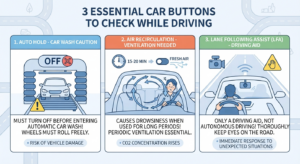
1. Auto Hold: Essential Caution for Car Washes
Auto Hold is a highly useful feature that maintains braking pressure even after you take your foot off the brake pedal while stopped, significantly reducing driver fatigue during city driving with frequent stop-and-go traffic.
When to be careful: When entering a tunnel-type automatic car wash.
Why: Tunnel car washes use a conveyor belt to move your car by pushing the wheels. If Auto Hold is active, the car will attempt to stay in a stationary state, preventing the wheels from rolling. This can cause the car to jump off the conveyor, collide with car wash equipment, and lead to vehicle damage or mechanical failure.
Recommended Habit: Make it a habit to turn off the Auto Hold function immediately before entering a car wash.
2. Air Recirculation: Cabin Air Quality and Drowsiness Prevention
The Air Recirculation mode blocks outside air (dust, exhaust fumes, etc.) from entering the cabin, keeping the interior environment pleasant. However, using it for extended periods can pose unexpected risks.
When to be careful: During long-distance driving or when the car is closed for a long time.
Why: The oxygen level inside the cabin drops while carbon dioxide levels rise rapidly. This can lead to decreased concentration, severe drowsiness, and headaches. Additionally, in winter or rainy weather, moisture inside the cabin cannot escape, leading to severe fogging on the windshield, which obscures your vision.
Recommended Habit: Switch to “Fresh Air” mode every 15 to 20 minutes to circulate fresh air. Note that the more passengers you have, the faster the carbon dioxide concentration rises, so more frequent ventilation is required.
3. Lane Following Assist (LFA): Understanding the Limits of Driving Assistance
LFA is a convenient feature that assists with steering to help keep the vehicle centered in its lane. However, this system has technical limitations that differ from human cognitive abilities.
When to be careful: On roads with faded lane markings, through construction zones, during severe weather (heavy rain or snow), or in unexpected situations.
Why: This feature uses a camera to recognize lane markings. If visibility is poor or the lane markings are unclear, the recognition rate drops drastically, and the system may suddenly disengage. Crucially, as the name suggests, it is an “assist” feature, not “autonomous driving.” The driver is legally responsible for any accidents.
Recommended Habit: You must keep your hands on the steering wheel and keep your eyes on the road at all times. Always be prepared to take manual control immediately. Remember, these systems are merely tools to reduce driver burden; the human driver is always the one in charge.
These features can greatly enhance your driving experience, but relying on them blindly is the most dangerous habit. By following these three principles—“Deactivate Auto Hold at the car wash, ventilate frequently during long drives, and remember that driving aids are only for assistance”—you will ensure a much safer and more comfortable driving experience.