In the contemporary gaming landscape, Intellectual Property (IP) has transcended its traditional legal definition to become the absolute epicenter of corporate strategy, market survival, and sustainable growth. As interactive entertainment evolves into a dominant global cultural force, the value of the IP—the foundational universe, characters, lore, and aesthetic identity—has surged to unprecedented heights.
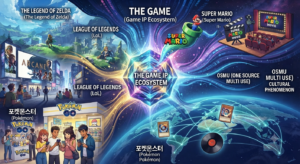
The Ecosystem of Iconic Gaming IP
The defining characteristic of market-leading IPs is their capacity to transcend the constraints of a single platform, effectively constructing self-sustaining ecosystems that permeate every facet of pop culture.
Pokémon: Originating as a modest handheld title in 1996, it has systematically expanded across anime, trading card games, extensive merchandise lines, and the AR phenomenon Pokémon GO, establishing itself as a multi-generational cultural icon.
League of Legends (LoL): By leveraging the sprawling universe of ‘Runeterra’ and its roster of distinct champions, Riot Games has executed a masterful ‘transmedia’ strategy. Through the critically acclaimed Netflix series Arcane, the IP successfully captured the attention of non-gamers, demonstrating that a deep, cohesive narrative can bridge the gap between niche gaming communities and mainstream entertainment.
Super Mario & The Legend of Zelda: These IPs serve as the bedrock of Nintendo’s corporate identity. By meticulously managing their evolution from simple platformers into diverse genres and high-profile film adaptations, they have become cultural touchstones that demonstrate enduring competitive resilience.
Why IP is the Singular Most Critical Factor in Modern Gaming Business
1. Cultivating ‘Emotional Equity’ as a Competitive Moat
Beyond mere gameplay, a powerful IP fosters profound emotional connections with its user base. When players develop genuine affection for a game’s characters, world-building, and lore, they build a sense of ‘Emotional Equity’. This deep-seated attachment creates an incredibly durable barrier to entry, or ‘moat,’ for competitors; it is nearly impossible for a rival title to replicate the years of shared memories and sentiment embedded within a beloved franchise.
2. Strategic Risk Mitigation and Marketing Efficiency
The gaming industry is notoriously volatile, often characterized by ‘hit or miss’ cycles where development costs are astronomical. Utilizing an established, high-affinity IP acts as a form of risk mitigation. It significantly diminishes the exorbitant customer acquisition costs associated with launching a new, unknown universe and guarantees immediate visibility, providing a level of financial stability and predictability that original titles simply cannot provide.
3. Unleashing the Potential of OSMU (One Source Multi Use)
Successful game IPs serve as the perfect engine for the ‘One Source Multi Use’ strategy. By funneling a core creative concept into diverse industries—including high-budget film productions, television dramas, digital webtoons, and interactive offline experiences like theme parks—companies can diversify their revenue streams. This diversification shields the organization from industry-specific downturns and scales the brand’s reach to the general public, exponentially increasing the total addressable market.
Conclusion: Beyond Technology to Cultural Permanence
Ultimately, the possession of a powerful IP is synonymous with the capitalization of decades of user trust, nostalgia, and communal experience. While technological advancements and high-fidelity graphics can be purchased or replicated with sufficient capital, the unique soul of an IP—its narrative richness and the emotional bond it maintains—is inimitable. The future trajectory of the global gaming market will be defined by a singular competition: determining which entities possess the most resonant, adaptable IPs and who can expand them with the greatest strategic vision.