1. Fundamental Principles of Programming: Software and System Architecture Integration
Computer programming is the structural process of defining computational logic through high-level specifications, transforming human intent into hardware-executable instruction sets. When an application runs within a modern Operating System (OS), complex background mechanics occur simultaneously, including virtual memory allocation, CPU process scheduling, and register arithmetic.
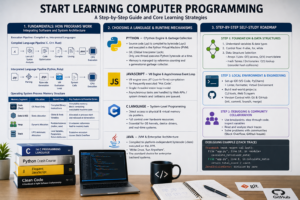
Execution Mechanics: Compiled vs. Interpreted Languages
Programming languages are primarily categorized by how source code is processed and translated into machine commands for processor execution.
[Compiled Language Pipeline]
Source (.c) -> Lexical/Syntax Analysis -> Code Optimization -> Compilation -> Linking -> Native Binary (.exe) -> CPU Execution

[Interpreted Language Pipeline]
Source (.py) -> Parsing -> Bytecode Generation (.pyc) -> Virtual Machine Evaluation Loop -> System Calls -> CPU Execution
Compiled Languages (C, C++, Rust):
Compilers like
gccorclangprocess the entire source codebase through lexical analysis, syntax parsing, intermediate code generation, and link-time optimization (Linking) to generate platform-native binary executables.These binaries run directly on target CPU architectures with minimal runtime overhead, delivering maximum execution speed and optimal memory efficiency.
Interpreted Languages (Python, Ruby):
Source code is evaluated line-by-line during runtime, converted into intermediate bytecode, and executed within a Virtual Machine (VM) runtime environment.
This architecture offers high developer productivity and platform independence, though it introduces runtime evaluation overhead compared to natively compiled binaries.
Operating System Process Memory Management Structure
When the operating system initializes an executable into an active process, RAM is partitioned into four distinct logical memory segments:
| Memory Segment | Allocation Mode | Stored Data Types | Key Characteristics & Potential Errors |
| Code (Text) | OS Read-Only | Compiled Binary Instructions | Immutable memory block housing executable machine code |
| Data & BSS | Static Allocation | Global & Static Variables | Allocated upon process startup; cleared on termination |
| Heap | Dynamic Allocation | Runtime Instantiations (malloc, new) | Unreleased references lead to severe Memory Leaks |
| Stack | LIFO Automatic | Local Variables, Parameters, Return Addresses | Excessive recursive calls trigger Stack Overflow |
2. Technical Language Selection & Runtime Mechanics Analysis
Python Architecture: CPython Engine & Garbage Collection
Python provides syntax readability and vast open-source libraries, making it an ideal choice for data science, artificial intelligence, and backend engineering.
CPython Execution Loop & Global Interpreter Lock (GIL):
The standard CPython implementation compiles
.pysource code into.pycbytecode, which is evaluated inside the PVM (Python Virtual Machine) loop.To ensure thread safety for internal memory management, CPython uses a Global Interpreter Lock (GIL). The GIL enforces that only one thread executes Python bytecode at a time per process. CPU-bound parallel workloads require using the
multiprocessingmodule to scale across multiple CPU cores.
Dynamic Typing & Automatic Memory Management:
Data types are resolved dynamically at runtime, treating every variable as an object.
Memory management uses reference counting combined with a generational Garbage Collector to detect and clean circular object references automatically.
JavaScript Architecture: V8 Engine & Asynchronous Event Loop
JavaScript is the core scripting language of web browsers, extended to server-side applications via the Node.js runtime.
V8 Engine JIT Compilation:
The Google V8 engine interprets code while dynamically identifying heavily executed “Hot Code” blocks, compiling them directly into native machine code at runtime via Just-In-Time (JIT) compilation.
Single-Threaded Event Loop Model:
JavaScript processes tasks via a single-threaded Call Stack. Asynchronous tasks (network requests, file I/O, timers) are offloaded to background Web APIs or system threads.
Completed asynchronous callbacks enter the Task Queue. The Event Loop continuously monitors the main Call Stack and pushes queue callbacks when the stack is empty, achieving non-blocking I/O execution.
C Language & Java: System-Level Programming and Enterprise Architecture
C Language: Grants direct access to physical and virtual memory addresses via pointers. It provides full control over hardware resources, making it essential for OS kernels, device drivers, and real-time systems.
Java: Compiles source code into platform-independent
.classbytecode executed by the Java Virtual Machine (JVM). Following the “Write Once, Run Anywhere” paradigm, Java remains a standard for enterprise-grade backend systems.
3. Structured Step-by-Step Self-Study Roadmap
Phase 1: Core Fundamentals & Computational Data Structures
Effective learning requires understanding how data is structured in memory and the computational complexity of algorithms.
Variable Allocation & Typing: Analyze how basic data types (
int,float,char) occupy memory bytes and map to binary representations.Control Flow Optimization: Study CPU branch prediction mechanisms in
if-elseblocks and index iteration efficiency inforandwhileloops.Data Structure Selection Criteria:
Arrays/Lists: Occupy contiguous memory locations allowing $O(1)$ random access, but incur $O(N)$ shift operations for mid-array insertions or deletions.
Hash Tables/Dictionaries: Map keys to indices via hash functions for $O(1)$ lookups, requiring strategies to mitigate potential hash collisions.
Phase 2: Local IDE Environment Setup & Practical Engineering Pipelines
Transitioning from simple code snippets to complete developer toolchains:
Development Environment Setup: Configure IDEs such as VS Code or JetBrains PyCharm with static code analyzers (Linters), formatters, and virtual environments (
venv,conda).Practical Project Engineering:
CLI Utility Development: Build command-line applications that manage file system I/O operations.
Web Data Extraction: Implement web scrapers using HTTP request libraries and DOM parsing techniques to collect structured data.
Version Control Integration (Git & GitHub):
Master core Git terminal pipelines (
git init,git add,git commit) and manage collaborative code branching strategies (git branch,git merge).
Phase 3: Interactive Debugging & Community Collaboration
Debugging involves analyzing system error stack traces to diagnose underlying runtime states:
Traceback (most recent call last):
  File "app.py", line 18, in <module>
    calculate_ratio(user_data)
  File "app.py", line 8, in calculate_ratio
    return total_score / count
ZeroDivisionError: division by zero
Interactive Debugging Workflows: Move beyond basic print statements by setting IDE breakpoints, stepping through execution lines (Step Over/Step Into), and inspecting memory variables dynamically.
Stack Trace Resolution Process: Extract exact error classifications (e.g.,
NullPointerException,IndexOutOfBoundsException) and trace messages to search technical communities like Stack Overflow and GitHub repository issue trackers.